
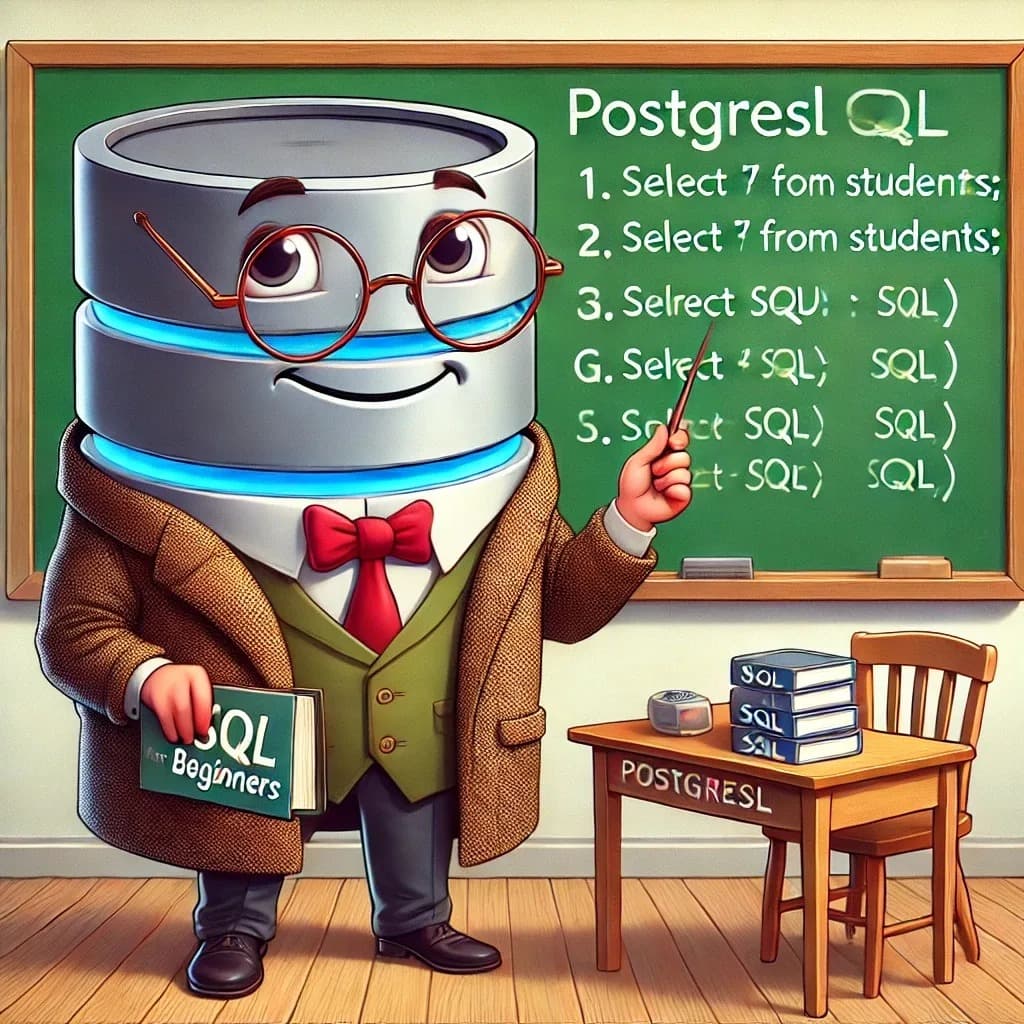
So, you have decided to learn PostgreSQL.
Excellent choice.
This means you are ready to enter the world of databases, tables, queries, relationships, and mysterious errors that somehow always appear right before lunch.
PostgreSQL is not just “a place where you put data”.
No.
PostgreSQL is a serious, powerful, open-source database system that politely says:
“Give me your data. I will organize it. Properly.”
And honestly, that is exactly what we want.
What Is PostgreSQL?
PostgreSQL is a relational database management system.
That sounds very serious, so let’s translate it into human language.
PostgreSQL helps you store, organize, search, update, and protect data.
It can store things like:
- users,
- products,
- blog posts,
- orders,
- comments,
- invoices,
- application settings,
- and all the other data your app will eventually collect before you start asking, “Why is this table so big?”
PostgreSQL uses SQL, which is the language we use to talk to relational databases.
For example, instead of politely asking:
“Dear database, could you please show me all users?”
You write something like:
SELECT * FROM users;
Short.
Direct.
A little bossy.
But databases like clarity.
Why Learn PostgreSQL?
Because data is everywhere.
Every serious application needs to store information somewhere.
A website without a database is often just a beautiful digital brochure.
A website with a database becomes something much more powerful.
It can remember users.
It can manage content.
It can track orders.
It can store posts, products, bookings, payments, messages, and all the other little details that make an application useful instead of decorative.
PostgreSQL is especially worth learning because it is:
- powerful,
- reliable,
- open-source,
- widely used,
- excellent for real-world applications,
- loved by backend developers who enjoy sleeping at night.
And yes, it can handle serious projects.
PostgreSQL is used by startups, companies, developers, data engineers, and people who have finally accepted that storing important data in random text files is not a life strategy.
PostgreSQL Is Not Scary
At first, databases can look intimidating.
There are tables.
There are columns.
There are primary keys.
There are foreign keys.
There are joins, indexes, constraints, transactions, and other words that sound like they escaped from a university exam.
But the idea is simple:
You have data.
You organize it.
You ask questions.
PostgreSQL gives answers.
Sometimes the answers are exactly what you wanted.
Sometimes the answers are empty because you forgot a semicolon, used the wrong table name, or wrote a query that looks like it was assembled during a power outage.
That is normal.
Databases are learned step by step.
Nobody becomes a PostgreSQL master by staring intensely at SELECT.
Although many have tried.
SQL: The Language of Databases
To work with PostgreSQL, you need SQL.
SQL lets you do things like:
CREATE TABLE users (
  id SERIAL PRIMARY KEY,
  name TEXT NOT NULL,
  email TEXT UNIQUE NOT NULL
);
That creates a table.
Then you can insert data:
INSERT INTO users (name, email)
VALUES ('Mario Rossi', 'mario@example.com');
Then you can read data:
SELECT * FROM users;
And just like that, you are communicating with a database.
You are not just clicking buttons anymore.
You are speaking database.
Careful now.
Power changes people.
What This Course Is About
This PostgreSQL course is built for beginners.
Not “beginners” who already know database normalization, indexing strategies, query planning, and three different ways to ruin production.
Real beginners.
People who want to understand databases from the ground up.
In this course, we will go step by step.
You will learn:
- what PostgreSQL is,
- how databases are structured,
- how tables work,
- how to write basic SQL queries,
- how to insert, update, and delete data,
- how relationships between tables work,
- how joins connect information,
- how constraints protect your data,
- how indexes improve performance,
- how backups save you from regret,
- and how to think like someone who does not fear databases anymore.
The goal is not just to memorize SQL commands.
The goal is to understand what you are doing.
Because copying commands is easy.
Understanding why they work is where the real power begins.
Also where the bugs become slightly less embarrassing.
What You Will Build
Throughout the course, you will not just read theory.
You will work with real examples.
You will create tables.
You will insert data.
You will write queries.
You will connect related data.
You will make mistakes.
You will fix them.
This is important because databases are not learned by watching from a distance like rare animals in a documentary.
You need to touch them.
Carefully.
With backups.
By the end, you should feel much more comfortable working with PostgreSQL and SQL.
Not necessarily like a database wizard living in a mountain cave.
But definitely like someone who can create a database without immediately whispering:
“Please don’t explode.”
Why PostgreSQL Is Great for Developers
If you are learning backend development, PostgreSQL is a fantastic choice.
It works beautifully with many technologies, including:
- Python,
- Django,
- Java,
- Spring Boot,
- Node.js,
- TypeScript,
- REST APIs,
- Docker,
- and many modern web applications.
That makes PostgreSQL a very practical skill.
If you build websites, apps, APIs, admin panels, dashboards, or business tools, sooner or later you will need a database.
And PostgreSQL is one of the best options you can learn.
It is serious enough for professional projects.
But friendly enough to learn step by step.
Like a strict teacher who actually wants you to pass.
Common Beginner Fears
Many beginners are afraid of databases because they seem too abstract.
You might think:
“What if I delete everything?”
Good question.
That is why we learn carefully.
You might think:
“What if I write the wrong query?”
You will.
Everyone does.
You might think:
“What if I do not understand joins?”
Welcome to the club.
Joins confuse almost everyone at first.
Then one day they suddenly make sense, and you feel like a curtain has opened.
A very nerdy curtain.
But still.
The point is: confusion is part of learning.
PostgreSQL is not impossible.
It is just a system with rules.
Once you understand the rules, it becomes much less scary.
Almost friendly.
Almost.
Who This Course Is For
This course is for you if:
- you are new to databases,
- you want to learn SQL,
- you are learning backend development,
- you want to use PostgreSQL in real projects,
- you want to understand how data is stored and connected,
- you are tired of pretending that databases are “something for later”.
This course is also useful if you already know a little SQL but want to organize your knowledge properly.
Because yes, you can write SQL for years and still suddenly discover that you misunderstood something basic.
Databases are humble like that.
They wait.
Then they teach.
Usually with an error message.
Why This Course Has Humor
Because learning databases can be dry.
Very dry.
Dry like old documentation printed in 1998 and stored in a basement near a lonely printer.
But databases are important, and important things do not have to be boring.
This course uses simple explanations, practical examples, and a little humor to make the journey easier.
You will still learn serious things.
You will still write real SQL.
You will still meet errors.
But at least you will not suffer in complete silence.
That is already progress.
Ready to Start?
PostgreSQL may look serious at first.
And it is serious.
But it is also logical, powerful, and incredibly useful.
Once you understand how databases work, you start seeing applications differently.
A login form is no longer just a login form.
A blog is no longer just a blog.
An online shop is no longer just a nice grid of products.
Behind everything, there is data.
And behind the data, there is probably a database trying very hard to behave.
So let’s learn how to work with it properly.
Start the PostgreSQL Course
Ready to begin?
You can start the full PostgreSQL course here:
Bring your laptop.
Bring your patience.
Bring coffee if necessary.
The database will behave.
Eventually.